Families Who Built Ballito
Five generations-deep stories of the families whose legacies are woven into the town's growth
 by
Jacqueline Herbst
· · Updated · 10 min read
by
Jacqueline Herbst
· · Updated · 10 min read
Ballito's story is shaped by families who farmed its land, built its businesses and strengthened its community long before the town boomed. In this feature, we celebrate the families whose legacies are woven into our town's growth across generations.
Burnedale Farm: 160 Years in Ballito's Story
More than a familiar and iconic landmark, Burnedale Farm is a living thread in the town's story, shaped by generations who have farmed, adapted and remained rooted to the land.
The site's history stretches back to 1862, when John Burne built his home thereafter completing his military service. He lived on the property until he passed away in 1905, after which the Robbins family – ancestors of the current custodians – purchased it. It has remained in the extended Robbins and Milstead lineage ever since. Barry Milstead, his daughter, Jackie (née Milstead) van der Zwan, her uncle Trevor, her brother Guy, and cousin Sean still work and live on their separate home farms, Upton and Karibu.
In 1849, the family received land allotments from the British government and settled in what would later become Umhlali. The plots were too small to sustain commercial farming, so James Robbins worked as a blacksmith while the family gradually acquired neighbouring land. Over time, they established a foothold for farming: first producing sugar cane with their own mill, diversifying into arrowroot in the 1870s, and returning to cane after securing a Tongaat Hulett contract in 1910.
The Burnedale homestead itself has been both a workplace and a family home. Initially rented out, it later sheltered successive generations, from Barry and Trevor in their early farming years to Trevor and Di Milstead, and Doug and Peggy Milstead. Peggy's enduring care of the gardens left a lasting imprint that still shapes the property's character today. When Barry purchased the surrounding land from the family, he formally established Burnedale Farm as both an agricultural space and a sanctuary.
For those connected to it, the farm holds decades of shared memory; a place where work and family life are intertwined, and where resilience is measured by continuity across generations. That resilience has taken many forms: diversifying crops, expanding into business ventures, and responding to economic change while keeping the land within the family. It also guided a more recent evolution: the opening of the Burnedale Bistro. Food became a natural bridge between farm and community, allowing the land to sustain itself financially while inviting others to experience its legacy.
Burnedale Farm stands as a reminder that Ballito's identity rests on families who nurtured its soil, adapted with the times, and carried their heritage forward, keeping the connection between land, livelihood and community as part of the town's character.
Ballito's identity rests on families who nurtured its soil, adapted with the times, and carried their heritage forward.
Serving Ballito: The Bothas & 30 Years of Wimpy
When Bobby and Cornelia Botha moved here in 1994 for health reasons, the commercial centre consisted of little more than a Spar, a corner bakery and a handful of small businesses. It was a close-knit community still finding its rhythm.
Cornelia, a teacher by profession, quickly became part of that rhythm. Joined by Ilze, also a teacher and later a long-standing business partner, Bobby and Cornelia set their sights on an opportunity that would leave a lasting imprint on the town's social fabric. In July 1996, they opened their first Wimpy in the village centre next to Spar, introducing not just a restaurant, but the "South African Breakfast" to Ballito. "I still remember the long queues outside the Wimpy during December holidays," Cornelia says.
The couple opened a second Wimpy at the Lifestyle Centre on 3 October 2003, and four years later, in November 2007, the original village restaurant relocated there. There were an unprecedented two Wimpy branches in the Lifestyle Centre, marking a first-of-its-kind concept in South Africa: a Wimpy designed specifically for families and children. "Many parents and children made fond memories there over the next 10 years, making the most of the play area under the iconic Sycamore trees," Cornelia reminisces.
Expansion continued alongside the town's development, and the move into Ballito Junction followed in 2017. Through each transition, the Lifestyle Centre branch remained a familiar meeting place; somewhere for business conversations, family outings and everyday catch-ups over coffee and breakfast.
Central to that continuity has been the people behind the counters and in the kitchens. "Our staff is an integral part of the success we experienced. They are part of the family, and some have been with us from the humble beginnings. We have celebrated their children's successes and lived through their tragedies." Cornelia is equally clear about the role customers played in shaping the story. "Over time, our customers became more than guests; they became part of our Wimpy family! It is an honour to have served so many customers over the years, and with the grace of God, we will continue to serve the next generation with the same love and passion," she says.
For the Bothas, bringing Wimpy to Ballito was never just about business growth. It was about creating gathering places in a town still defining itself. Three decades later, their contribution reflects how family enterprise and community life have grown side by side, one plate at a time.
From R50 to Retail: The Power Family's Story
Quentin Power recalls that his family arrived in Ballito around 1981, drawn by opportunity and a desire for a different way of life. Much of the area was still coastal forest, with scattered homes and open spaces where children roamed freely.
His father, Willie Power, had retired from the corporate world after serving as a technical director at Chubb, and later working in manufacturing, he decided to pursue commercial fishing full-time. Quentin remembers how tough those early days were. With four children to support and little income, the family faced uncertainty. He vividly recalls one particular day when his father, down to his last R50, fuelled the boat and headed out to sea. He returned with the boat brimming with fish – a turning point that led to the purchase of an old Ford Cortina bakkie and the founding of Rewop Home Maintenance as a backup business.
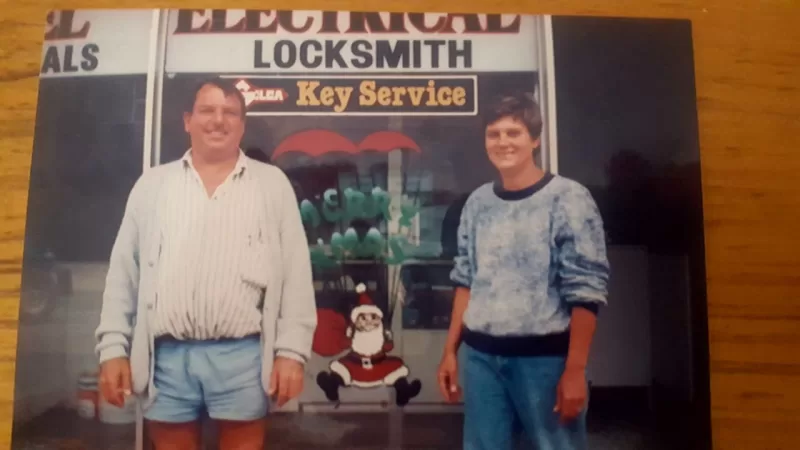
To supplement the family income, Quentin's mother, Mercia, co-founded Merzel Electrical, the area's first electrical outlet and appliance repair shop. From those humble beginnings, the Power family became integrated into the town's growth.
Quentin says his father believed in building both business and community. Through Rewop Home Maintenance and later hardware ventures, he offered employment to many local youngsters, often giving troubled teens a fresh start. The family helped build and paint municipal housing projects in Phoenix and Inanda, employing nearly 200 staff at one stage. They also built the building behind the Lifestyle Centre (where ACDC is now) before it was built, as well as the Build It building (now BBS Mica Build) on Moffat Drive.
Community service became a hallmark of the Power family name. His father was instrumental in the Lions Club's early fundraising events, including the popular "Amazing Race" and soapbox derbies. Quentin and his brother, William, contributed to founding the Ballito Lifesaving Club at Clarke Bay, launching a Nippers programme and training lifeguards from surrounding informal areas, some of whom still serve on our local beaches today. The brothers also helped establish a volunteer fire department before there was a formal station, and Quentin later became a police reservist.
From a small key-cutting shop, the Powers grew into hardware retail, eventually building what became one of the country's top-performing Build It stores, supplying major projects including stadium construction for the 2010 World Cup. Through it all, Quentin says he remembers the freedom of early Ballito – quiet beaches, push-starting fire trucks and a town where everyone knew each other – and a father whose determination influenced his family's and the town's future.
The Hulett Legacy: Roots of Ballito's North Coast Story
We sat down with Lynne Hulett, wife of the late Michael Hulett, to trace the story of a family name deeply woven into the fabric of the greater North Coast. The Hulett name remains proudly borne by many descendants still living in the district. At the last family reunion, held at Collisheen Estate in 2009, 400 Huletts gathered, a testament to the family's enduring local presence.
The story begins with Sir Liege Hulett, a 19-year-old who arrived in Durban by ship in 1857. He paid a £20 fare from Great Britain and stepped ashore with just £5 in his pocket. He initially worked as an apothecary's assistant before purchasing land in Mount Moreland, where he cleared the bush himself and began cultivating arrowroot. He later leased 600 acres in the Nonoti area, eventually buying the property and naming it Kearsney, after a village in Kent.
By 1888, 200 acres of land had become a tea plantation, the crop that made his fortune, contrary to popular belief that it was sugar. Sugar cane was grown only on a small scale at that stage. Sir Liege married Mary Balcomb, and they had six sons and two daughters. He founded Kearsney College in 1921 at Kearsney Manor near Stanger; the school relocated to its current site at Botha's Hill in 1939. Generations of Hulett sons attended the school.
From the tower at Kearsney Manor, Sir Liege would watch ships at the Tugela Mouth. Known for using trees to add colour to the landscape, he earned the isiZulu nickname Umtshali Wezihlahla, meaning "planter of trees". He maintained extensive orchards alongside his twenty-two-bedroom home. In 1901, he planted sugar cane at Tinley Manor and ordered machinery for the first Hulett sugar mill. Mills followed at Darnall, Amatikulu, Felixton and Empangeni, laying the groundwork for what would become Tongaat Hulett. Knighted in 1902 at the coronation of King Edward VII after serving as Minister of Native Affairs in Natal and Zululand, Sir Liege also secured a concession to build a railway line between Somkele and Empangeni following the discovery of coal.
The family's footprint across the North Coast is significant. Land once owned by the Huletts today includes estates such as Brettenwood Coastal Estate, Collisheen, Shortens Country Estate, Manor Estates and Umhlali Country Club, amongst others; a lasting legacy of a family whose roots run deep in Ballito's soil.
Pioneers of Umhlali: The De Charmoy & Robert Families
Long before the name "Ballito" carried weight, the De Charmoy and Robert families were building lives along the North Coast. French-Mauritian identical twin brothers, Charles and Tommy de Charmoy, arrived in South Africa by boat in the late 1800s in search of opportunity. To disembark, each passenger needed five shillings. Family lore has it that the twins shared a single coin, discreetly passing it back and forth to satisfy officials.
They settled in the sugar belt and became prominent cane farmers. The De Charmoys and the Roberts, already close friends in Mauritius, saw their ties strengthened in South Africa as their children intermarried in the Ballito and Umhlali area. Of Charles's four children, three married into the Robert family, cementing a partnership that would shape the district for generations.
Charles de Charmoy was known as a hard-working community man. He travelled to Durban on horseback for supplies, long before the N2 or M4 existed. Beyond farming, he famously introduced the anthurium industry to South Africa, establishing extensive anthurium houses in the Rietvalley area. His footprint on the coastline remains visible. In 1962, he built the large tidal pool at Thompson's Bay, still known as "Charlie's Pool". He pushed for the coastal road linking Thompson's Bay and Chaka's Rock in the 1960s, opening access along the shoreline. He also built a hospital for soldiers returning from war.
A devout and patriotic Frenchman, Charles built the Roman Catholic church in Shakaskraal and even donated a fire engine to the French Army. The family spoke French at home and flew the French flag on their properties. Despite hosting prominent visitors, including then Prime Minister Hendrik Verwoerd, he avoided the limelight. Charles preferred khaki clothes, braces, Gauloises cigars and a Sunday card game.
The family owned significant tracts of land, including the farm on which Manor House, part of Lalela Estate, stands. Properties at Thompson's Bay later became developments such as Maricelle and Santorini, and the original family beach cottage stood across from where Salt Café is today. Now into their fifth generation in Umhlali, the extended De Charmoy and Robert families remain involved in farming and business. Their contributions include Flag Animal Farm, the redevelopment of Sugar Village in Umhlali, and the award-winning Robert Group.
Jennifer Robert is clear: they are from Umhlali. They have stayed to preserve the heritage and the childhood memories anchored there, continuing a legacy built quietly and largely without fanfare.
Written by
Jacqueline Herbst
Jacqui brings a style of storytelling that informs and engages readers.
READ MORE
Southern Africa celebrates KZN resort achieving benchmark in best practice for green buildings
by The Ballito Writer · September 17, 2026

Inside-Out Skincare
by The Ballito Writer · September 17, 2026
Chris & Alley
by Mariska Moodley · September 7, 2026